Scoring with Confidence
Writing evaluator guidance: what each answer must evidence to score. Procurement officers who write evaluation guidance, and panel chairs who want consistent, defensible scores.
- Price
- £14.99 per learner, no VAT
- Time
- 2 to 3 hours
- Level
- Practitioner
- Access
- Lifetime, including updates
- Pathway
- Stage 3: Build and evaluate the tender
By the end, you'll be able to
- Turn a vague question into one that can be scored consistently
- Write evidence indicators and score descriptors for every point on the scale
- Score, write rationales and moderate the way a challenge would expect
- Use your record to write clear assessment summaries
5 modules, each with something to do
Every module ends in a short test. Every answer is explained. Pass the final assessment to receive your certificate.
- 01
Why evaluator guidance matters
Why adjective-only scales produce a spread of scores, what the Act expects, and why hidden checklists become hidden criteria.
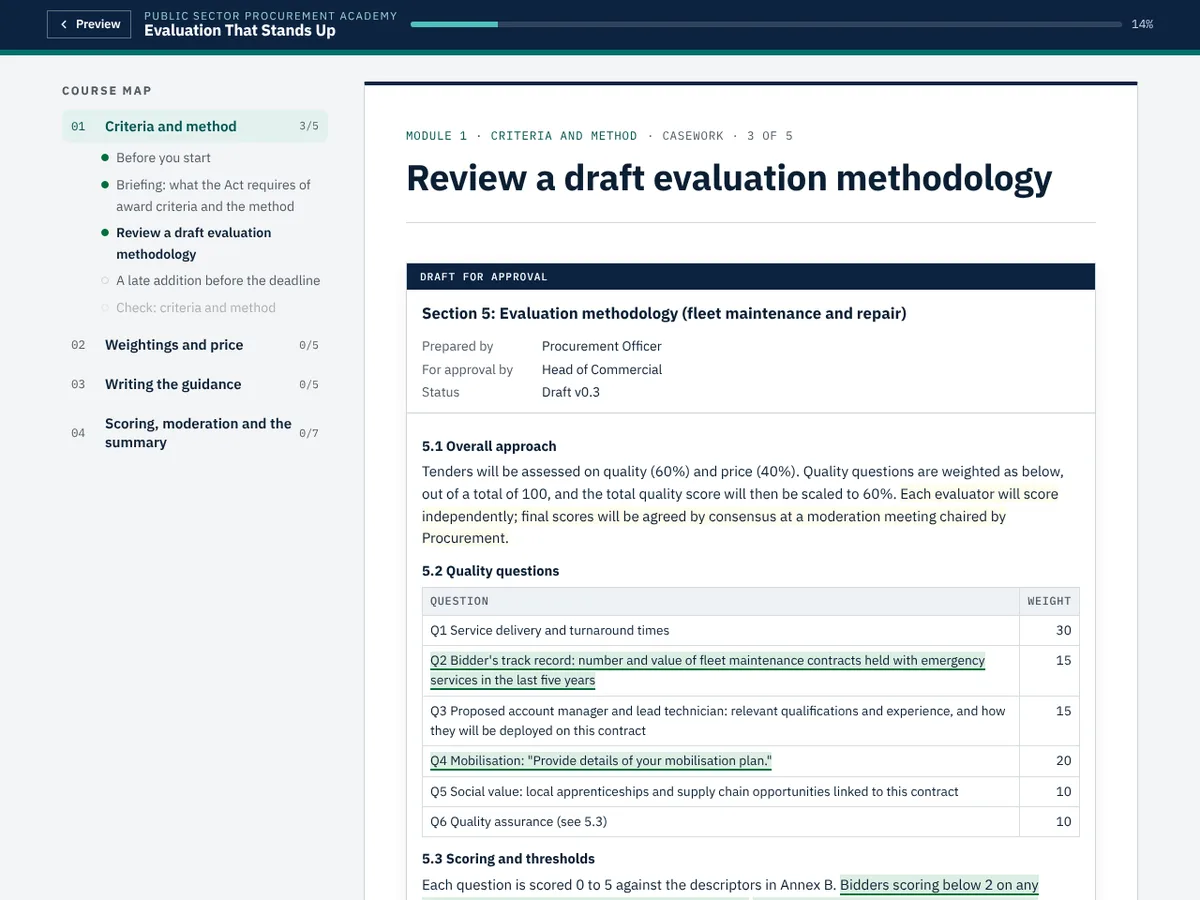
Hands-on: Score an answer using adjectives only, then see your colleagues' scores
- 02
Precise questions
The five parts of a scoreable question, and the difference between claims, commitments and evidence.
Hands-on: Sort eight real-style questions, and pick the best rewrite
- 03
Writing the guidance
Evidence indicators, score descriptors, minimum thresholds and the six common mistakes.
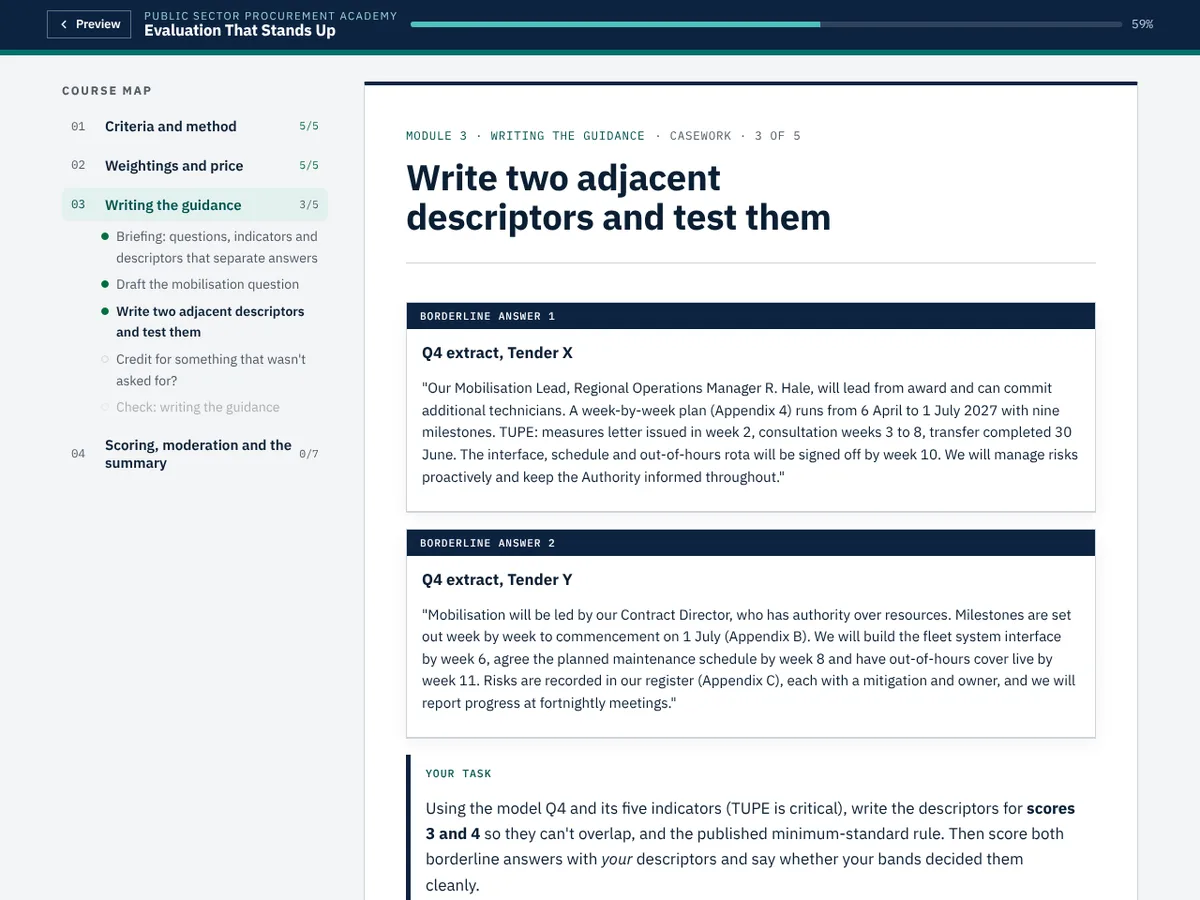
Hands-on: Build the guidance for a mobilisation question and copy it into your own template
- 04
Scoring and moderation
Independent scoring, rationales and moderation by evidence rather than averages.
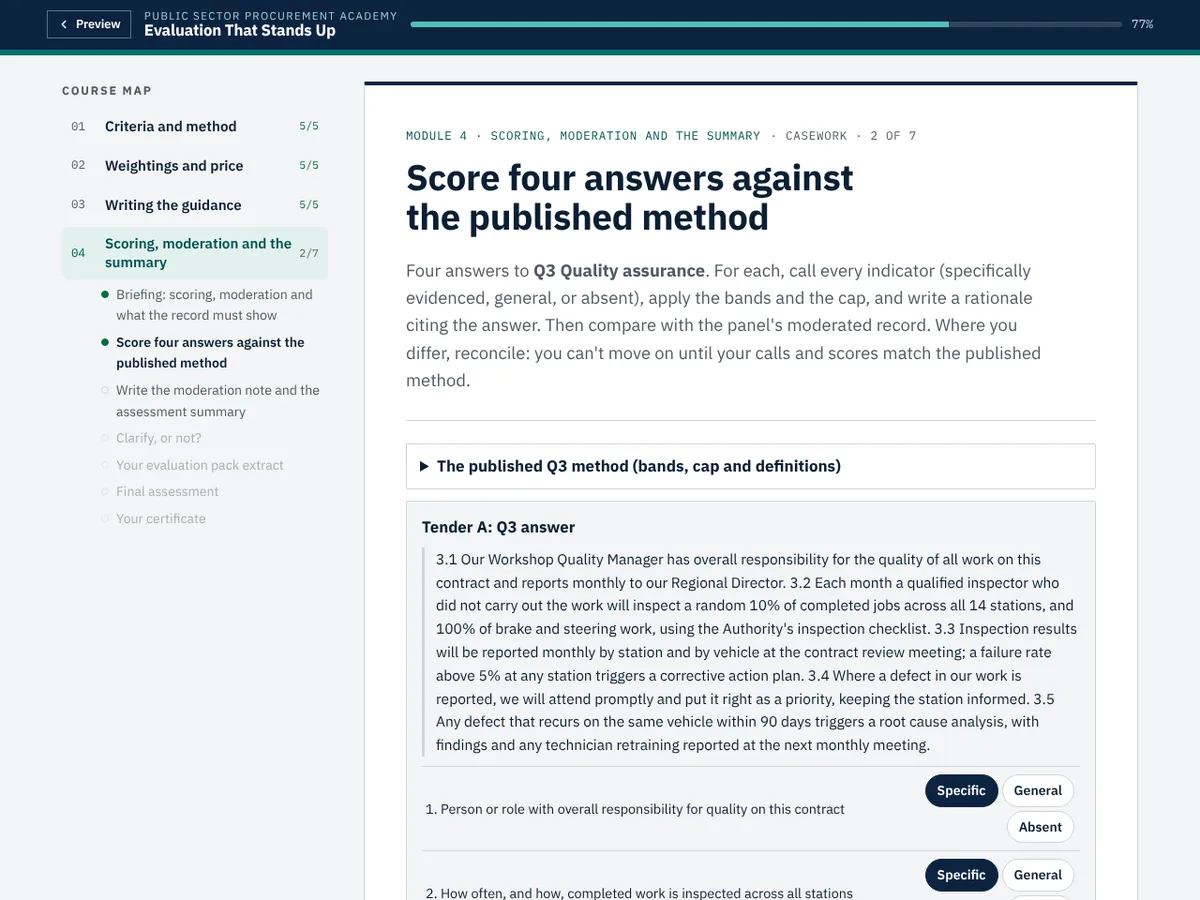
Hands-on: Score three tender answers, then moderate with the panel
- 05
Feedback, challenge and assessment
From guidance to assessment summary, and auditing someone else's guide.
Hands-on: Audit a published scoring guide, then the final assessment
See what you'll actually do
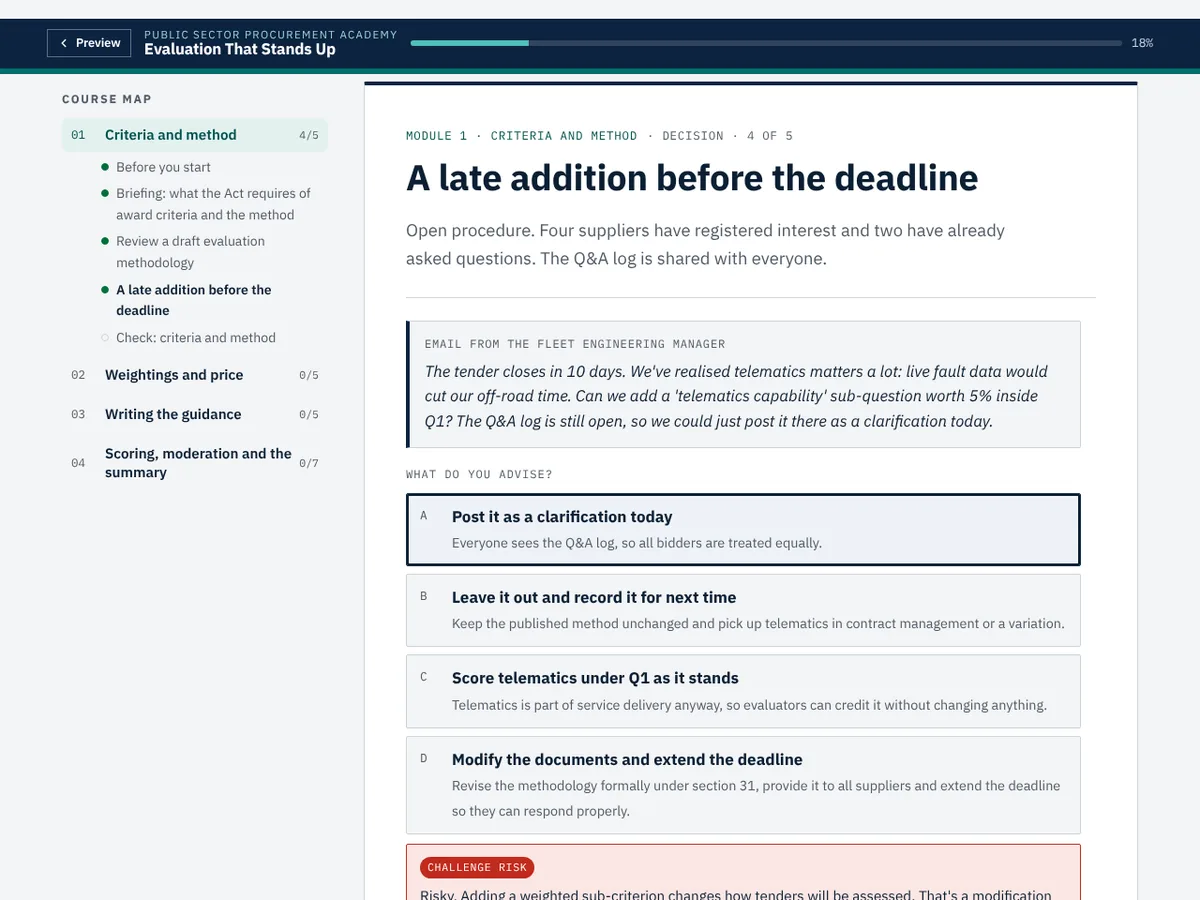
One screen at a time, with a course map, a decision log and a test at the end of every module. Try Module 1 free, no sign-up needed.
What this course covers, and how you're assessed
Written for the Procurement Act 2023 as it applies in England, and reviewed whenever the law or guidance changes.
What's covered
- The Procurement Act 2023 and Procurement Regulations 2024 as they apply in England
- Contracting authorities buying goods, services and works, above and below threshold
- Good practice that holds whatever the regime
What isn't
- Scotland's procurement rules, which are separate
- Rules specific to Wales and Northern Ireland, which differ in places
- The NHS Provider Selection Regime for healthcare services
- Legal advice on a live procurement
How you're assessed
- A short test at the end of every module, with every answer explained
- 80% to move on; retake as often as you like
- A final assessment, then a certificate with an ID anyone can check online
Proof you can show your manager
Procurement AcademyCertificate of completion
 Tim Young FCIPS
IoSCM Ambassador · AET-qualified TutorPSPA-105-EXAMPLE
Verify online
Each certificate has a unique ID that anyone can check on our verification page. It's a certificate of completion for independent training, not a formal qualification.
Written by a practitioner
Every course is written by Tim Young FCIPS: more than 25 years in procurement across the public and private sectors, a former CIPS examiner and assessor, CIPS tutor at Levels 3 to 6, AET-qualified and an IoSCM Ambassador.
Before you start
How long do I have access?
For life. Pay once and the course stays in your account, including every update we make to it, for as long as we offer the course. If we ever withdraw a course, we'll give you at least 12 months' notice.
What does "including updates" mean?
When the law, guidance or thresholds change, we update the course and you get the new version automatically. Your progress is kept.
Does this count towards the Tender Ready pathway?
Yes. If you buy the pathway later, what you paid for this course comes off the pathway price automatically at checkout, as long as you’re signed in.
Are these courses up to date with the Procurement Act 2023?
Yes. Courses are written for the Procurement Act 2023 as it applies in England, which came into force on 24 February 2025. Each course shows the date its content was last reviewed, and you keep access to updates.
How is this different from the free Procurement Act learning?
The Cabinet Office's free learning explains what the Act says, and it's worth doing. These courses sit alongside it: you practise applying the rules to realistic cases, make decisions and see the consequences, with feedback on every answer.
Can my organisation pay by invoice?
Yes. For two or more learners we set up access and invoice your organisation, so you can raise a purchase order. See For organisations.
Is VAT charged?
No. The Academy is run by Young Procurement, which is not VAT registered, so the price you see is the price you pay.
Is this a CIPS qualification?
No. Each course ends in a certificate of completion with an ID that anyone can check online. It's independent training, not a formal qualification.